
Models are improving fast. Adoption still happens one useful product at a time.
Last week brought two more high-end AI models, OpenAI’s new enterprise voice product and wider U.S. access to ChatGPT Health. Here is what changed—and what would have to happen for HCPs and patients to use these tools more often.
Coverage: July 19–25, 2026 · Standard window · 9-minute read
Last week’s launches pointed to one simple lesson: people adopt solutions to their problems. They do not adopt a model name, a natural-sounding voice or a health tab simply because it exists.
Better models matter when they make a useful product work better. Voice matters when the conversation finishes a job. Health AI matters when people return after the first question—and trust the next step.
IN ONE MINUTE
01
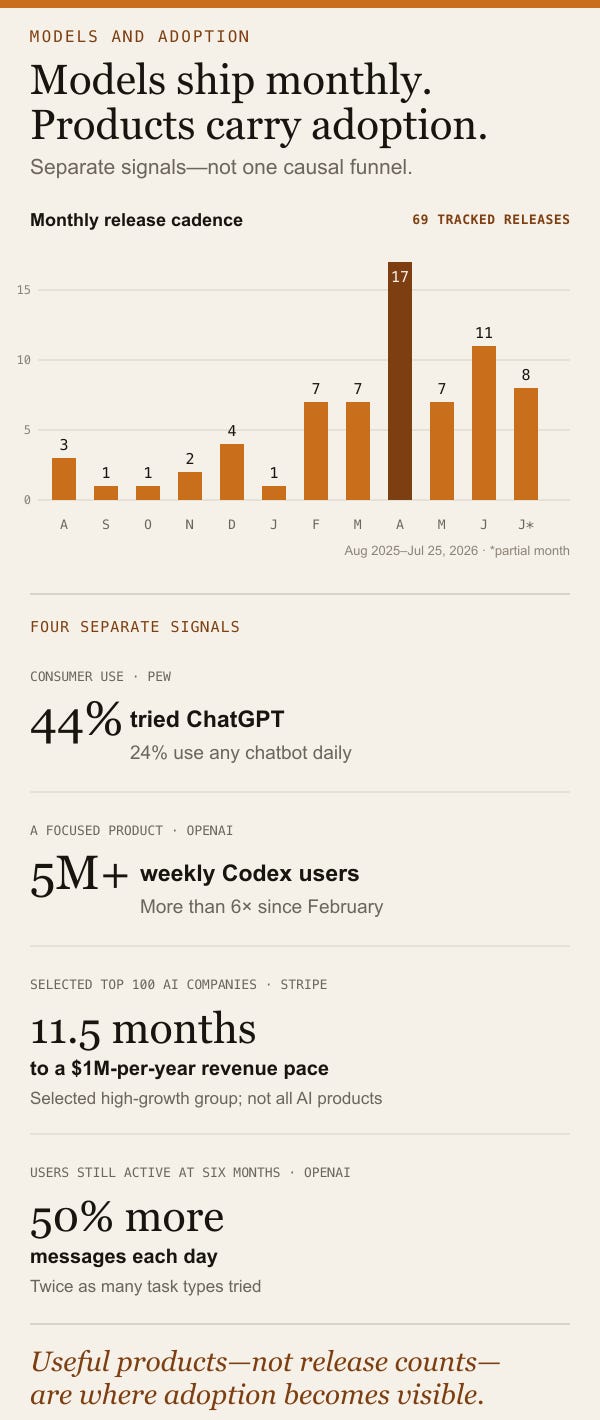
Models: Alibaba previewed Qwen3.8 and Anthropic launched Claude Opus 5. They were two of 69 tracked releases, versions and previews in the past 12 months. The adoption story is what products do with them.
02
Voice: OpenAI improved ChatGPT Voice with GPT-Live on July 8, then launched a new enterprise product named Presence on July 22. Presence helps a company turn voice or chat into a controlled service.
03
Health: ChatGPT Health expanded across U.S. consumer plans on July 23. Friday’s Alert covered the launch; this Weekly looks at who may use it repeatedly and what could slow adoption.
01
Better models matter when a useful product carries the improvement to people
Why this matters: the assistants people already use can become more capable or cheaper between annual planning cycles. Pharma will feel the change through better products—not because HCPs or patients select a model themselves.
What happened last week
Alibaba previewed Qwen3.8-Max on July 19; independent results were not available. Anthropic launched Claude Opus 5 on July 24. Artificial Analysis ranked Opus 5 narrowly first and estimated a 26% lower cost per test task than Anthropic’s Fable 5. It also gave Opus 5 a 50% score on its measure of made-up or unsupported claims—proof that “better” is not one number.
They were two of 69 entries in the DemandSphere tracker over the past 12 months. July produced eight. An entry can be a model, a version at a different price or speed, or a preview—not a completely new invention.
What the numbers do—and do not—show
U.S. labs accounted for 41 entries, Chinese labs for 24 and other labs for four. U.S. labs lead this tracker by volume. Chinese labs increase competition on price, access and choice. That can help companies build products, but the data do not show that release volume caused more startups or more users.
A focused product: OpenAI says Codex passed five million weekly users, more than six times its level after the desktop product launched in February.
Customer demand: Stripe’s selected top 100 AI companies reached a sales pace equivalent to $1 million a year in a median 11.5 months—faster than a comparable group of software companies.
Deeper use: in an OpenAI group, users still active after six months sent 50% more messages per day and had tried twice as many kinds of tasks.
These signals show activity at different layers. They do not prove that one converts into the next—or that a particular model made people return.
Why this lands with HCPs and patients
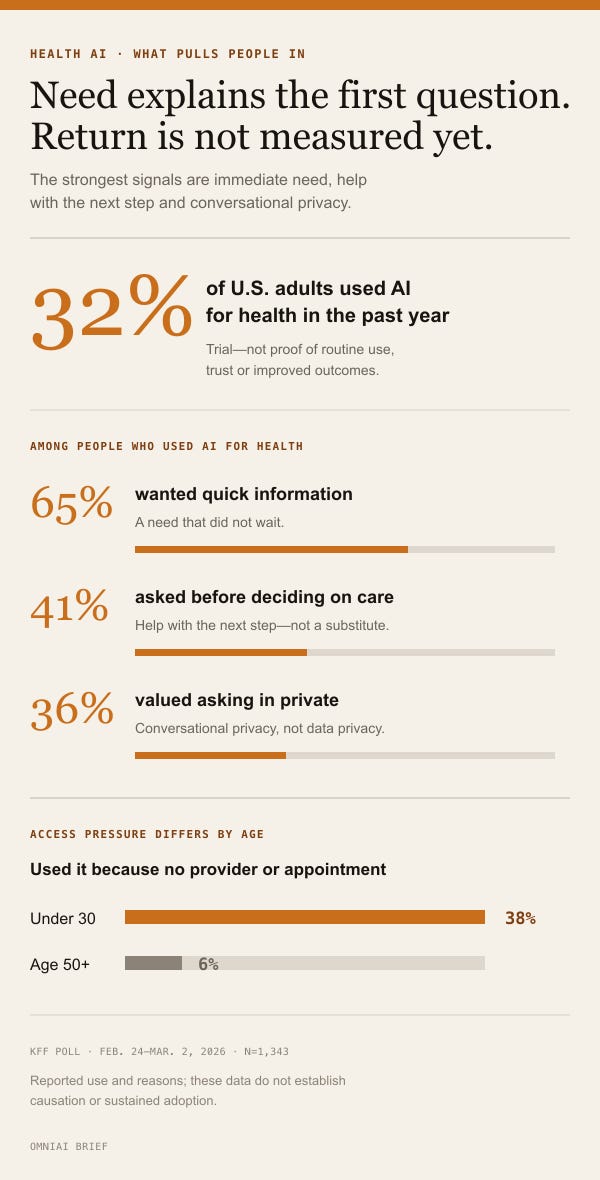
The AMA found 72% of surveyed physicians reported at least one work use; Doximity found 37% reported daily use; and KFF found 32% of U.S. adults had used AI for health information. These measures can include documentation or administrative work. They do not show that physicians trust AI for clinical decisions—or that better models caused the use.
Newer, cheaper models can help products handle longer evidence, answer follow-ups and reduce cost. More use still depends on strong sources, a recurring need and a safe next step. For field leadership, the immediate task is to capture comparative questions, citation requests and AI-shaped misconceptions—then improve approved resources and coaching, not ask representatives to identify AI users.
WORTH EXPLORING · NOT A MODEL MIGRATION
Six questions worth watching
The omnichannel insights lead should choose one indication and run this with a Medical or approved-content reviewer. Define the expected answer and authoritative sources first; use no patient or confidential information.
Ask three HCP questions: What changed in the evidence? Who is an appropriate patient? What safety or monitoring information matters? Ask three patient questions: What does this result mean? How do the options differ? What should I ask at my next visit?
Record the tool, version, account type, market, date and exact prompt. Check accuracy, currency and sources. This is an environment scan—not product validation or field content.
Evidence note: The model tracker changes over time. The usage figures come from different datasets and cannot be combined into a causal trend. AMA and Doximity results are self-reported.
02
OpenAI’s Presence closes an enterprise voice gap—not the last adoption gap
Two launches, two different jobs
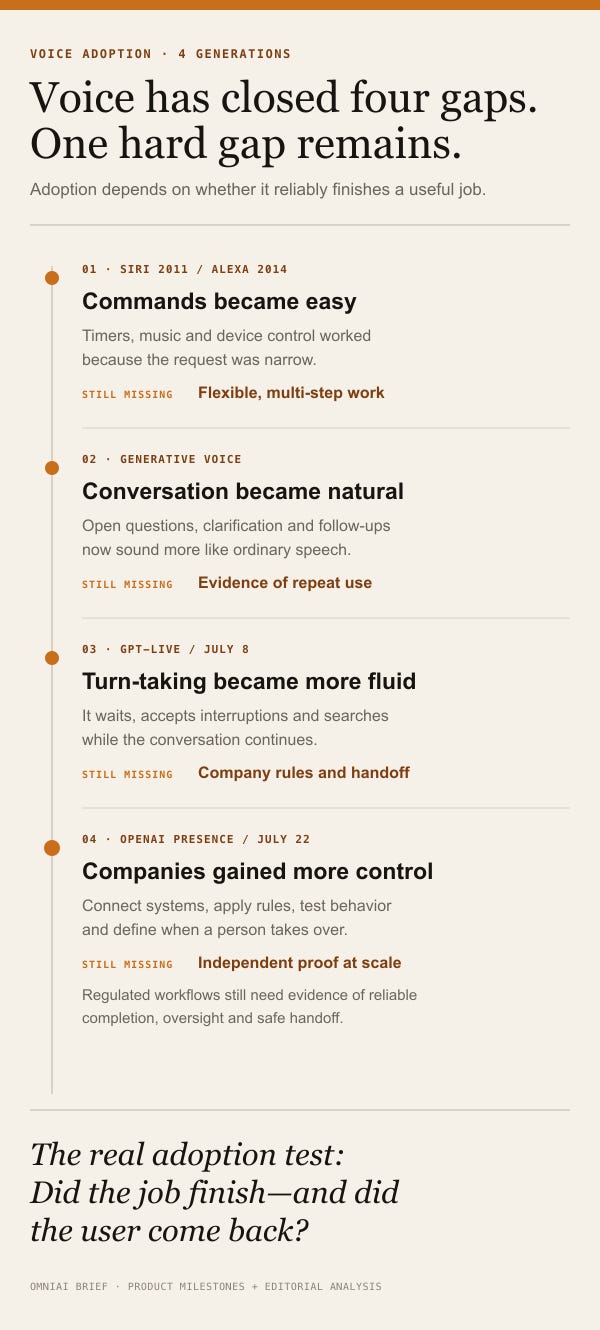
On July 8, OpenAI released GPT-Live, the technology now powering ChatGPT Voice. Older systems often waited for a person to stop talking and mistook a pause for the end. GPT-Live can listen and speak at once, wait while someone thinks, accept an interruption and send a harder question to another model for search or reasoning.
On July 22, OpenAI introduced a different product: Presence. It helps a company build one voice or chat service around one defined job. OpenAI engineers and selected implementation partners connect the company’s systems, approved actions, rules, tests and human handoff. Without Presence, the company must assemble those pieces itself or through other vendors.
Presence is available only to selected enterprise customers. OpenAI says its own phone service resolves 75% of inbound issues without a person and reduced handoffs by 15 percentage points in ten days. BBVA, SoftBank and IAG are exploring or testing it. Independent results at scale are not available.
What still blocks broad adoption
Siri arrived in 2011 and Alexa in 2014. Amazon says more than 600 million Alexa devices exist; Pew found 35% of U.S. adults own a smart speaker. Voice became familiar for timers, music and device control—not complicated work.
OpenAI says more than 150 million people each week use ChatGPT Voice or Dictation, but it does not split conversation from simple dictation. In the independent tau-Voice benchmark, text completed 85% of 278 simulated service tasks; voice agents completed 26%–38% with realistic accents and noise. It was not a Presence or pharma test, but it shows why natural speech is not enough.
Our view: this is a meaningful signal for narrow, clearly defined jobs—not proof of broad voice adoption. Amazon says Alexa+ reached tens of millions of customers and doubled conversation activity in nine months, but it did not define that measure. For regulated use, the critical signals are repeat use, high task completion, easy correction and dependable human handoff—not a date on the calendar.
Why this lands in pharma
Possible uses range from call-note dictation and medical role-play to support-program navigation and appointment preparation. A customer-facing agent might route a medical-information request, possible adverse event or product-quality complaint—with the caller’s words preserved, a defined routing time and human confirmation—but should not improvise a clinical or promotional answer.
A beautiful voice is not the business case. Successful completion and a safe handoff are.
WORTH THINKING THROUGH · NO PILOT REQUIRED
Where would voice truly make a difference?
Keep only uses where speaking is clearly easier than typing or tapping. Then ask: Can the user correct it? Can we define a correct outcome? Can identity, consent, logging and human handoff work? Would failure be visible before harm occurs?
Explore further only when voice has a distinct advantage and every control answer is convincing. This is prioritization—not a request to test voice with representatives.
Evidence note: OpenAI and Amazon usage figures are vendor-reported. Presence has no independent scaled evaluation; tau-Voice is independent but simulated and non-pharma.
03
ChatGPT Health has reach. Repeat use will take more than reach.
A brief follow-up to Friday’s Alert
Friday’s Alert covered the U.S. rollout. This Weekly adds one question: who is likely to turn access into a habit—and what could slow them down?
Health in ChatGPT expanded across U.S. consumer plans on July 23 and can use connected health information when a user gives permission. Distribution is immediate. Lasting behavior is not.
Who is most likely to use it first
KFF found younger adults use health AI more often. Among current users, 65% wanted quick information, 41% wanted information before deciding whether to see a provider, and 36% valued asking without another person present. Among users under 30, 38% cited no regular provider or no appointment, compared with 6% of users aged 50 and older.
Strongest evidence today: younger or access-constrained users, and people facing a new result, symptom or diagnosis.
Plausible but unproven: faster adoption by rare-disease patients and caregivers.
Measured: older adults currently report lower direct use.
Unknown: comparative adoption among stable chronic patients; our hypothesis is that a recurring benefit will matter because portals and care teams are strong alternatives.
Portal history suggests durable health habits build over years
ASTP/ONC found that the share of people offered and using a patient portal rose from 25% in 2014 to 65% in 2024. Use was higher among people encouraged by a healthcare professional—87% versus 57%—although the observational data cannot show that encouragement caused the difference.
ChatGPT has broader general consumer reach than early portals did. That does not mean users have complete connected health data or a trusted clinical path. Our editorial judgment is that broad, repeat health use will take years—not weeks—unless four observable gates are cleared: complete enough data, trustworthy answers and sources, an easy path to a professional, and a recurring job worth returning for.
Why this lands in pharma
KFF found 19% of U.S. adults had used AI to explain tests, results or diagnoses; the same share used it to compare treatments. Pharma should watch whether questions become more comparative and source-demanding—not identify ChatGPT users. Connected records can be incomplete, 77% express privacy concern, and consumer apps do not automatically carry provider-level HIPAA protections.
WORTH TRYING · START WITH EXISTING DATA
The monthly question-shift scan
Review a small sample of medical-information or patient-support contacts. Tag five things: comparison of options, explanation of a result, request for a source, apparent misconception, and need for professional follow-up.
Keep the same channels, markets, sample size and definitions each month. Share only aggregated themes. Do not guess which callers used AI.
Evidence note: KFF surveyed 1,343 U.S. adults February 24–March 2, 2026. Patient portals are context, not a clock for ChatGPT Health.
THE OMNIAI CALL
Better technology deserves attention. Repeat use deserves the decision.
Watch which products solve a real problem well enough that HCPs and patients come back.
Thank you for subscribing. If you have 30 seconds and something to say, reply—I’d genuinely like to hear it.